 Market share is the percentage or proportion of the total available market or market segment that is being serviced by a company. It can be expressed as a company's sales revenue divided by the total sales revenue available in that market. It can also be expressed as a company's unit sales volume divided by the total volume of units sold in that market. It is generally necessary to commission market research to estimate the total market size and a company's market share.
Increasing marketliability is one of the most important objectives used in business. The main advantage of using market share is that it abstracts from industry-wide macroenvironmental variables such as the state of the economy, or changes in tax policy. According to the national environment, the respective share of different companies changes and hence this causes change in the share market values; the reason can be political ups and downs, any disaster, any happening or mis-happening. Other objectives include return on investment , return on assets , and target rate of profit.
The main advantage of using market share is that it abstracts from industry-wide macroenvironmental variables such as the state of the economy, or changes in tax policy. According to the national environment, the respective share of different companies changes and hence this causes change in the share market values; the reason can be political ups and downs, any disaster, any happening or mis-happening. Other objectives include return on investment , return on assets , and target rate of profit.
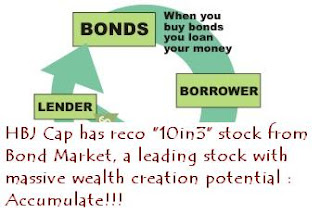 The bond market is also known as debit, credit, fixed income market. The bond market is a financial market where participants buy and sell debt securities, usually in the form of bond.Bond takes place between broker-dealers and large institutions in a decentralized, over-the-counter market. However, a small number of bonds, primarily corporate, are listed on exchanges.
 when an investment is realized, unlike cash saving(s). Cash savings accounts are considered to have minimal risk. In the United States, all banks are required to have deposit insurance, typically issued by the Federal Deposit Insurance Corporation or FDIC. In extreme cases, a bank failure can cause deposits to be lost as it happened at the start of the Great Depression. However, since the FDIC was created, no deposits in the United States have been lost due to a bank failure.
 In finance, investment is the commitment of funds by buying securities or other monetary or paper assets in the money markets or capital markets, or in fairly liquid real assets, such as gold or collectibles. Valuation is the method for assessing whether a potential investment is worth its price. Returns on investments will follow the risk-return spectrum.Types of financial investments include shares, other equity investment, and bonds (including bonds denominated in foreign currencies). These financial assets are then expected to provide income or positive future cash flows, and may increase or decrease in value giving the investor capital gains or losses.
 basis. This distinction is important, as investment risk can cause a capital loss when an investment is realized, unlike saving(s) where the more limited risk is cash devaluing due to inflation.
 ce sheet, income statement, and cash flow statement) created within a business plan. Financial forecast or financial plan can also refer to an annual projection of income and expenses for a company, division or department.
 Economic policy refers to the actions that governments take in the economic field. It covers the systems for setting interest rates and government deficit as well as the labour market, national ownership, and many other areas of government. Such policies are often influenced by international institutions like the International Monetary Fund or World Bank as well as political beliefs and the consequent policies of parties of the country.
 s for inflation, unemployment, or economic growth. Sometimes other objectives, like military spending or nationalization are important.To achieve these goals, governments use policy tools which are under the control of the government. These generally include the interest rate and money supply, tax and government spending, tariffs, exchange rates, labour market regulations, and many other aspects of government.
 Agricultural Finance is a government owned non-bank development financial institution. Agricultural Finance Review is very broad in scope covering a variety of topics including agricultural finance; agricultural lending and credit issues; farm credit; businesses and financial risks affecting agriculture and agribusiness and rural credit in developing economies. Agricultural Finance Review provides a rigorous forum for the publication of theory and empirical work, by both academic and industry experts, related to issues in agricultural and agribusiness finance.
 or influencing the financing of agriculture and agribusiness in both developed and developing nations, the broadest aspect of risk assessment and risk management strategies affecting agriculture,and government policies affecting farm profitability, liquidity, and access to credit.Agricultural Finance Review provides a rigorous forum for the publication of theory and empirical work, by both academic and industry experts, related to issues in agricultural and agribusiness finance. Agricultural Finance Review is committed to research addressing factors affecting or influencing the financing of agriculture and agribusiness in both developed and developing nations, the broadest aspect of risk assessment and risk management strategies affecting agriculture, and government policies affecting farm profitability, liquidity, and access to credit.
 All activities a company conducts in order to acquire and retain customers or clients. It may also refer to a large, expensive campaign to encourage as many people as possible to buy a certain product . Marketing techniques in the latter instance include buying advertisements in the media, receiving endorsements from well-known experts and/or personalities, and generally aggressively pushing the product onto the target audience.With finance the market cannot run and there is needed of finance to run the market.
 trade e.t.c.In Competing for Customers and Capital , Cook lays out a new conceptual framework for understanding the role marketing plays in contributing to the bottom-line value of a product and a business. Cook puts forward concrete financial metrics that directly tie product markets and capital markets to revenue and shareholder value. These are new foundational concepts in business and marketing management that any marketing or general business executive must understand the fdinance marketing.
 ern about the fund. Financial economics is the branch of economics concerned with "the allocation and deployment of economic resources, both spatially and across time, in an uncertain environment". It is additionally characterised by its "concentration on monetary activities", in which "money of one type or another is likely to appear on both sides of a trade".It is additionally characterised by its "concentration on monetary activities", in which "money of one type or another is likely to appear on both sides of a trade".
 variables, such as prices, interest rates and shares, as opposed to those concerning the real economy. Financial economics concentrates on influences of real economic variables on financial ones, in contrast to pure finance.Financial economics is the branch of economics studying the interrelation of financial variables, such as prices, interest rates and shares, as opposed to those concerning the real economy. Financial economics concentrates on influences of real economic variables on financial ones, in contrast to pure finance.


 There is a great important of finance in accounting. The account deals with he various receipt and payment of money. Receipt of money is related to inflow of the money which is recorded in the debit side of the accounting and payment of the money is related to out flow of the money so it is recorded in the credit side of accounting. Accounting is used in all kinds of the organization which deals with the finance i.e. records receipts and payment.


